Michał Molenda, Adam Busławski, Dorota Krówczyńska, Dorota Zierkiewicz, Stanisław Manulik, Piotr Pobrotyn
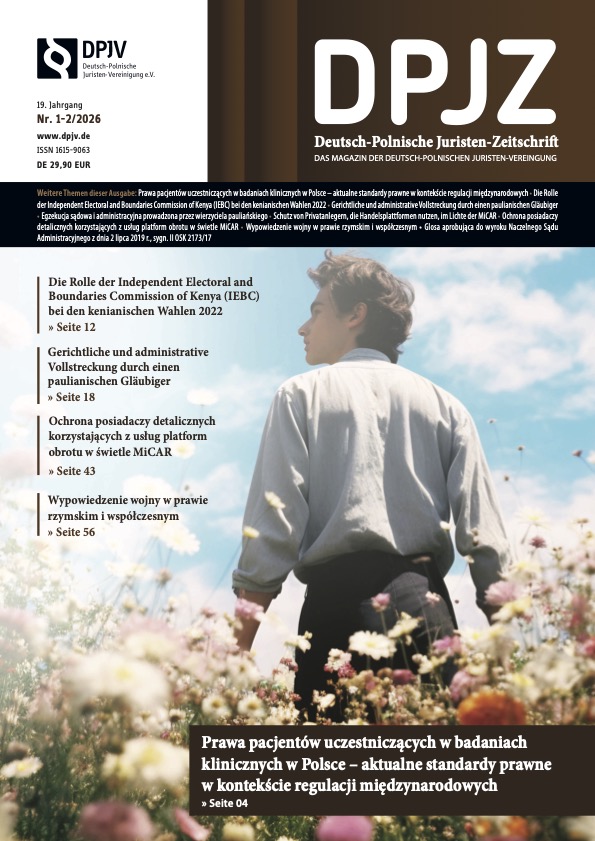
Prawa pacjentów uczestniczących w badaniach klinicznych w Polsce – aktualne standardy prawne w kontekście regulacji międzynarodowych
The rights of patients participating in clinical trials in Poland – current legal standards in the context of international regulations
Rechte von Patienten, die an klinischen Studien in Polen teilnehmen – aktuelle Rechtsstandards im Kontext internationaler Vorschriften
Streszczenie: Celem artykułu jest analiza praw pacjenta uczestniczącego w badaniach klinicznych w Polsce w świetle regulacji międzynarodowych. W opracowaniu przedstawiono ewolucję standardów ochrony uczestników badań – od Kodeksu Norymberskiego, przez Deklarację Helsińską i zasady Dobrej Praktyki Klinicznej (ICH-GCP), po współczesne regulacje unijne, w tym Rozporządzenie (UE) 536/2014. Głównym punktem odniesienia w polskim porządku prawnym jest ustawa z 9 marca 2023 r. o badaniach klinicznych, która kompleksowo reguluje obowiązki badaczy, sponsorów oraz prawa uczestników. Omawiane prawa pacjenta obejmują m.in. prawo do dobrowolnego udziału, świadomej zgody, wycofania się z badania bez ponoszenia konsekwencji, dostęp do informacji, ochronę danych osobowych, bezpłatny udział, bezpieczeństwo oraz możliwość uzyskania odszkodowania za powstałe szkody zdrowotne. Autorzy wskazują na pełną zgodność polskich regulacji z międzynarodowymi standardami, a także na innowacyjne mechanizmy, takie jak Fundusz Kompensacyjny Badań Klinicznych i Naczelna Komisja Bioetyczna (NBK). Wnioski z przedłożonej pracy podkreślają wysoki poziom ochrony praw pacjenta w Polsce oraz znaczenie transparentności, nadzoru etycznego i edukacji uczestników jako warunków etycznego prowadzenia badań klinicznych. Polska implementacja rozwiązań unijnych stanowi przykład dobrej praktyki w harmonizacji regulacji z potrzebami uczestników i wymogami etyki badań medycznych.
Summary: The aim of this article is to analyze the rights of patients participating in clinical trials in Poland in the light of international regulations. The study presents the evolution of standards for the protection of trial participants – from the Nuremberg Code, through the Declaration of Helsinki and the principles of Good Clinical Practice (ICH-GCP), to contemporary EU regulations, including Regulation (EU) 536/2014. The main point of reference in the Polish legal system is the Act of March 9, 2023, on clinical trials, which comprehensively regulates the obligations of investigators, sponsors, and the rights of participants. The patient rights discussed include, among others, the right to voluntary participation, informed consent, withdrawal from the trial without consequences, access to information, personal data protection, free participation, safety, and the possibility of obtaining compensation for any damage to health. The authors point to the full compliance of Polish regulations with international standards, as well as innovative mechanisms such as the Clinical Trials Compensation Fund and the Supreme Bioethics Commission (NBK). The conclusions of the submitted work emphasize the high level of patient rights protection in Poland and the importance of transparency, ethical supervision, and participant education as conditions for the ethical conduct of clinical trials. Poland’s implementation of EU solutions is an example of good practice in harmonizing regulations with the needs of participants and the requirements of medical research ethics.
O autorach: Michał Molenda, Department of Legal Advisors, 4th Military Clinical Hospital in Wroclaw, Poland, Lower Silesian Cell Transplantation Centre Ltd. In Wrocław, Poland, https://orcid.org/0009-0002-2282-736X, E-mail mmolenda@4wsk.pl.
Adam Busławski, Department of Management and Logistics, WSB Merito University in Opole, Poland, https://orcid.org/0000-0002-6329-278X, e-mail: adambuslawski@gmail.com,
Dorota Krówczyńska, Cardinal Stefan Wyszynski Institute of Cardiology in Warsaw, Poland, Department of Nursing and Obstetrics, Collegium Mazovia in Siedlce, Poland, Department of Nursing, Józef Piłsudski University of Physical Education in Warsaw, Poland, https://orcid.org/0000-0002-3928-3162, e-mail : dkrowczynska@o2.pl.
Dorota Zierkiewicz, Department of Nursing, Wroclaw Medical University, Poland, Lower Silesian Oncology, Hematology and Pulmonology Center in Wroclaw, Poland, https://orcid.org/0009-0002-4102-7261, e-mail: dorota.zierkiewicz@umw.edu.pl.
Stanisław Manulik, Department of Nursing, Wroclaw Medical University, Poland. https://orcid.org/0000-0003-4292-161X, e-mail: stanislaw.manulik@umw.edu.pl
Piotr Pobrotyn, Citodent Dental Center Furtak-Pobrotyn & Company Limited Partnership, Olawa, Poland, https://orcid.org/0000-0001-9216-451X, e-mail:pobrotynp@gmail.com.
Correspondence to:
Michał Molenda, Department of Legal Advisors, 4th Military Clinical Hospital, Weigla 5 Street, 50-981 Wroclaw, Poland; E-mail: mmolenda@4wsk.pl
Magdalena Maksymiuk
Die Rolle der Independent Electoral and Boundaries Commission of Kenya (IEBC) bei den kenianischen Wahlen 2022
The role of the Independent Electoral and Boundaries Commission of Kenya (IEBC) in the Kenyan elections 2022
Zusammenfassung: Demokratisierungsprozesse auf dem afrikanischen Kontinent stehen im 21. Jahrhundert nach wie vor, vor sozialen und politischen Hindernissen. Dies liegt daran, dass sie die Achtung der Menschenrechte, die Gewährleistung der Gewaltenteilung, die Rechtsstaatlichkeit, die Unabhängigkeit der Justiz oder die Abhaltung freier Wahlen erfordern. Nach dem Vorbild der Lösungen westlicher Länder und unter Berücksichtigung der Transparenz und Fairness von Wahlen wurde in Kenia beschlossen, die Unabhängige Wahl- und Grenzkommission Kenias (im Folgenden IEBC) einzurichten. Im Laufe der Jahre stieß sie auf viele Schwierigkeiten im Zusammenhang mit der Organisation der Wahlen in Kenia, die auf die politische und rechtliche Lage sowie die ethnischen Spaltungen im Land zurückzuführen waren. Der Hauptzweck dieses Artikels besteht daher darin, zu untersuchen, welche Rolle die IEBC bei den Präsidentschaftswahlen 2022 gespielt hat und welche Maßnahmen sie ergriffen hat, um die Wahlen demokratisch zu gestalten und die bei früheren Wahlen aufgetretene Wahlgewalt zu verhindern. Die Schlussfolgerungen am Ende der Arbeit enthalten einen Versuch, Empfehlungen für das Vorgehen der Kommission zu geben.
Schlüsselwörter: Wahlen, Kenia, Wahlkommission
Summary: Democratization processes on the African continent in the 21st century still face social and political obstacles. This is because it requires respect for human rights, guaranteeing the separation of powers, the rule of law, the independence of the judiciary or the holding of free elections. Following the example of the solutions of Western countries, and at the same time keeping in mind the transparency and fairness of elections, in Kenya it was decided to establish the Independent Electoral and Boundaries Commission of Kenya (hereinafter IEBC). Over the years, it has encountered many difficulties, related to the organization of Kenya’s elections, resulting from the political and legal situation and ethnic divisions in the country. The main purpose of this article, therefore, is to examine what role the IEBC played in the 2022 presidential election and what measures it employed to make the election democratic and prevent the electoral violence found in previous elections. The conclusions concluding the work contain an attempt to recommend the commission’s actions.
Key words: elections, Kenya, electoral commission
Über die Autorin: Dr. Magdalena Maksymiuk, Juristische Fakultät, Universität von Stefan Wyszynski in Warschau, https://orcid.org/0000-0001-5711-4920, E-Mail: m.maksymiuk@uksw.edu.pl.
Grzegorz Kamieński
Łukasz Mikowski
Gerichtliche und administrative Vollstreckung durch einen paulianischen Gläubiger
Judicial and administrative enforcement carried out by a pauliana creditor
Zusammenfassung: Am 16. Juni 2021 hat der Oberste Gerichtshof in einer Besetzung von sieben Richtern eine äußerst wichtige Entscheidung getroffen (III CZP 60/19, OSNC 2021 Nr. 10, Pos. 62, S. 19) erlassen, dessen Gegenstand die Klärung der Frage war, welche Stellung ein Gläubiger aus einem paulianischen Rechtsstreit hat, zu dessen Gunsten ein Veräußerungs- oder Belastungsverbot für eine Immobilie erlassen wurde, was erhebliche Auswirkungen auf die gerichtliche Vollstreckung hatte, daein Paulianischer Gläubiger, der über ein rechtskräftiges Urteil mit Vollstreckungsklausel verfügt, sich einem bereits laufenden Vollstreckungsverfahren anschließen oder an der Aufteilung des Vollstreckungsbetrags teilnehmen kann. Gleichzeitig hat der Gesetzgeber mit der Novellierung des Gesetzes zur Änderung des Gesetzes über Vollstreckungsverfahren in der Verwaltung und einiger anderer Gesetzeneue Lösungen eingeführt,unter anderem im Bereich der Befriedigung aus Vermögensvorteilen, die durch eine zum Nachteil des Gläubigers vorgenommene Rechtshandlung erzielt wurden. Die Autoren analysieren die oben genannten Änderungen, die sich erheblich auf die Position des Paulianischen Gläubigers auswirken und gleichzeitig Änderungen in diesem Bereich sowohl bei der gerichtlichen als auch bei der Verwaltungsvollstreckung einführen.
Stichworte: Verwaltungsvollstreckung, Gesetz über das Vollstreckungsverfahren in der Verwaltung, Paulianische Klage, Paulianischer Gläubiger, Benachteiligung von Gläubigern
Summary: On June 16, 2021, the Supreme Court, composed of seven judges, issued an extremely important resolution (III CZP 60/19, OSNC 2021 No. 10, item 62, p. 19), which the subject was to resolve the issue concerning the position of the paulian creditor, for which there was a ban on selling or encumbering the property, which had a significant impact on judicial enforcement, because a pauliana creditor who has a legally binding judgment with an enforceability clause may attach join the ongoing enforcement proceedings or take part in the division of the sum resulting from the enforcement proceedings execution. At the same time, by amending the Act amending the Act on enforcement proceedings in administration and certain other acts, the legislator introduced new solutions, including: in the scope of satisfying the property benefits obtained as a result of a legal action to the detriment of the creditor. Autors analyzes the above changes, which significantly affect the position of the pauliana creditor and at the same time introduce changes in this respect, both in judicial enforcement and administrative enforcement.
Keywords: administrative enforcement, act on enforcement proceedings in administration, actio pauliana, creditor pauliana, harm to creditors
Über die Auoren: Rechtsanwalt Dr. Grzegorz Kamieński, Akademie der Wissenschaften Angelusa Silesiusa, Rechtsanwalt Dr. Łukasz Mikowski,Rechtsanwalt Dr. Grzegorz Kamieński, Akademie, e-mail: mikowskilukasz@gmail.com.
Jędrzej Kuderski
Schutz von Privatanlegern, die Handelsplattformen nutzen, im Lichte der MiCAR
Protection of retail holders using trading platform services under MiCAR
Zusammenfassung: Die MiCAR-Verordnung führt einen einheitlichen Rechtsrahmen für den Krypto-Asset-Markt in der Europäischen Union ein, der den Schutz von Kleinanlegern sowie die Erhöhung der Transparenz und Sicherheit des Handels zum Ziel hat. Sie führt die Verpflichtung ein, den Status eines CASP (Crypto-Asset Service Provider) für Unternehmen zu erwerben, die Börsen betreiben und Dienstleistungen im Zusammenhang mit Krypto-Assets erbringen. CASP unterliegen strengen Lizenz-, Kapital- und organisatorischen Anforderungen, einschließlich Verpflichtungen im Bereich der IKT-Sicherheit gemäß der DORA-Verordnung. Obwohl diese Vorschriften das Risiko von Missbrauch und Cyberangriffen verringern, garantieren sie keinen vollständigen Schutz der Anleger, insbesondere angesichts unzureichender Mindestkapitalanforderungen.
Schlüsselwörter: MiCAR, Privatanleger, Krypto-Asset-Börsen, CASP, Krypto-Assets
Über den Autor: Steuerberater für Mitglieder internationaler Kapitalgruppen tätig, seine wissenschaftlichen Interessen umfassen die Themen Krypto-Assets und Steuern, E-Mail:j.kuderski2001@wp.pl.
Jędrzej Kuderski
Ochrona posiadaczy detalicznych korzystających z usług platform obrotu w świetle MiCAR
Protection of retail holders using trading platform services under MiCAR
Streszczenie: Rozporządzenie MiCAR wprowadza jednolite ramy prawne dla rynku kryptoaktywów w Unii Europejskiej, mające na celu ochronę inwestorów detalicznych oraz zwiększenie przejrzystości i bezpieczeństwa obrotu. Wprowadza ono obowiązek uzyskania statusu CASP (Crypto-Asset Service Provider) dla podmiotów prowadzących giełdy i świadczących usługi związane z kryptoaktywami. CASP podlegają rygorystycznym wymogom licencyjnym, kapitałowym i organizacyjnym, w tym obowiązkom w zakresie bezpieczeństwa ICT, zgodnie z rozporządzeniem DORA. Choć regulacje te ograniczają ryzyko nadużyć i cyberataków, nie gwarantują pełnej ochrony inwestorów, zwłaszcza wobec niewystarczających minimalnych wymogów kapitałowych.
Summary: The MiCAR Regulation introduces a uniform legal framework for the crypto-asset market in the European Union, aimed at protecting retail investors and increasing transparency and security of trading. It introduces the requirement to obtain CASP (Crypto-Asset Service Provider) status for entities operating exchanges and providing services related to crypto-assets. CASPs are subject to stringent licensing, capital, and organizational requirements, including ICT security obligations, in accordance with the DORA Regulation. While these regulations mitigate the risk of abuse and cyberattacks, they do not guarantee full investor protection, especially given the insufficient minimum capital requirements.
O autorze: Zawodowo zajmuje się doradztwem podatkowym na rzecz członków międzynarodowych grup kapitałowych, zainteresowania naukowe obejmują tematykę kryptoaktywów oraz podatków, e-mail: j.kuderski2001@wp.pl.
Mateusz Pyzik
Wypowiedzenie wojny w prawie rzymskim i współczesnym
Declaration of War in Roman and Contemporary Law
Streszczenie: Artykuł przedstawia porównanie procedur wypowiadania wojny w prawie rzymskim oraz we współczesnym prawie międzynarodowym publicznym. W starożytnym Rzymie akt wypowiedzenia wojny miał charakter ściśle sformalizowany i rytualny, oparty na obrzędach religijnych oraz zasadzie bellum iustum. Analizie poddano m.in. rolę kolegium fecjałów, procedurę rerum repetitio oraz symboliczne znaczenie rzutu włócznią. W części dotyczącej prawa współczesnego omówiono rozwój regulacji od konwencji haskich, przez Pakt Ligi Narodów, po Kartę Narodów Zjednoczonych. Wskazano także wyjątki od zakazu użycia siły, w tym prawo do samoobrony, działania Rady Bezpieczeństwa ONZ oraz kontrowersyjne przypadki interwencji zbrojnych. Autor podkreśla, że choć zmieniły się przesłanki dopuszczalności wojny, zasada jej ograniczania pozostaje wspólnym mianownikiem obu epok.
Summary: The article compares the procedures of declaring war in Roman law and in contemporary public international law. In ancient Rome, the act of declaring war was strictly formalized and ritualized, grounded in religious ceremonies and the principle of bellum iustum. The analysis covers the role of the fetiales priesthood, the rerum repetitio procedure, and the symbolic significance of throwing a spear. The section on modern law examines the development of regulations from the Hague Conventions, through the Covenant of the League of Nations, to the United Nations Charter. It also outlines exceptions to the prohibition on the use of force, including the right to self-defense, UN Security Council actions, and controversial cases of military intervention. The author emphasizes that while the legal grounds for war have evolved, the principle of its limitation remains a common thread across both eras.
Keywords: Roman law, declaration of war, bellum iustum, public international law, self-defense, use of force, United Nations
O autorze: student na Wydziale Prawa i Administracji Uniwersytetu Kardynała Stefana Wyszyńskiego w Warszawie, zainteresowania naukowe obejmują prawo międzynarodowe publiczne, prawo Unii Europejskiej i prawo gospodarcze, e-mail: Mateuszp2003@wp.pl.
Przemysław Charzewski
Glosa aprobująca do wyroku Naczelnego Sądu Administracyjnego z dnia 2 lipca 2019 r., sygn. II OSK 2173/17
Approval gloss to the judgment of the Supreme Administrative Court of 2 July 2019 r., sygn. II OSK 2173/17
Streszczenie: W dniu 2 lipca 2019 r. Naczelny Sąd Administracyjny (dalej NSA) orzekał w przedmiocie odmowy przyznania ograniczonego prawa wykonywania zawodu pielęgniarce będącej cudzoziemką. Pielęgniarka nie ukończyła szkoły pielęgniarskiej, a pomaturalną, w rezultacie czego NSA zgodził się ze stanowiskiem NRPiP, co do niespełniania przez cudzoziemkę koniecznego wymogu. W prawdzie opis stanu faktycznego sprawy wydaje się częściowo enigmatyczny, co do szczegółów dotyczących skarżącej pielęgniarki, nie mniej jednak z informacji zawartych w wyroku wynika, że pielęgniarka zabiegała o to, by w związku z niemożnością przyznania ograniczonego prawa wykonywania zawodu, stwierdzić prawo wykonywania zawodu. Trafnie jednak oceniono, że przyznawanie ograniczonego prawa wykonywania zawodu, jak również stwierdzanie prawa wykonywania zawodu ma różne podstawy prawne, których nie wolno stosować zamiennie. Stanowisko to, przyjęte przez NSA, zasługuje na poparcie, co postaram się wykazać w niniejszej glosie.
Summary: On 2 July 2019. The Supreme Administrative Court issued a judgment on the refusal to grant a limited right to practice to a nurse who is a foreigner. The nurse had not graduated from a nursing school, but from a post-secondary school, and therefore the Supreme Administrative Court also agreed with the position of the Supreme Council of Nurses and Midwives as to the foreigner’s failure to meet the necessary requirement. In truth, the description of the facts of the case appears to be partially enigmatic as regards the applicant nurse’s data, nevertheless, it is apparent from the information contained in the judgment that the nurse was seeking a declare of limited right to practice her profession due to her inability to be granted this right. However, it was correctly assessed that the grant of a limited right to practice and the declare of the right to practice have different legal bases, which must not be used interchangeably. This position, adopted by the Supreme Administrative Court, deserves support, as I will try to demonstrate in this gloss.
O autorze: wykładowca idoktor nauk prawnych w dziedzinie prawa administracyjnego w Collegium Witelona Uczelnia Państwowa w Legnicy, ORCID: 0000-0003-3760-7992, mail: przemyslaw.charzewski@collegiumwitelona.pl.