Julia Słowińska
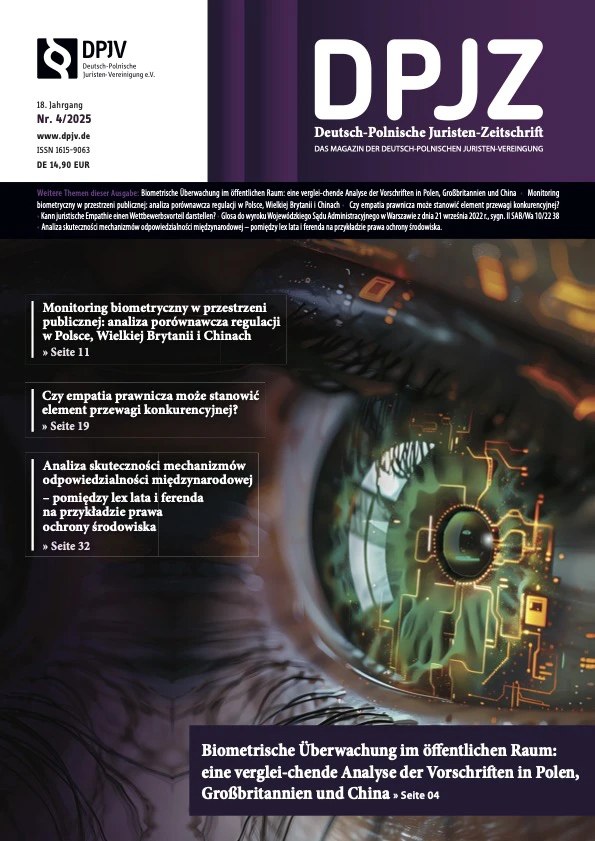
Biometrische Überwachung im öffentlichen Raum: eine vergleichende Analyse der Vorschriften in Polen, Großbritannien und China
Biometric Surveillance in Public Spaces: A Comparative Analysis of Regulations in Poland, the United Kingdom, and China
Zusammenfassung: Der Beitrag analysiert die gesetzlichen Regelungen zur biometrischen Überwachung im öffentlichen Raum in Polen, Großbritannien und China unter besonderer Berücksichtigung der Gesichtserkennungstechnologie. Mit Hilfe der vergleichenden und rechtlichen Methode werden die Ziele, der Umfang und die Mechanismen der Aufsicht über diese Technologien in drei verschiedenen Rechtsordnungen diskutiert. Die Analyse weist auf erhebliche Unterschiede in den Regulierungsansätzen hin, die vom restriktiven Rahmen der Europäischen Union bis hin zur umfassenden Überwachung in China reichen. Besondere Aufmerksamkeit gilt der KI-Verordnung (AI Act), die direkte und strenge Einschränkungen für den Einsatz biometrischer Überwachung in den EU-Mitgliedstaaten vorsieht. Der Artikel schlägt Postulate vor, die darauf abzielen, ein Gleichgewicht zwischen der öffentlichen Sicherheit und dem Schutz der Rechte des Einzelnen zu gewährleisten.
Schlüsselwörter: biometrische Überwachung, Gesichtserkennung, KI-Gesetz, Schutz personenbezogener Daten, Rechtsvergleichung, Überwachung
Abstract: The article examines legal regulations governing biometric surveillance in public spaces in Poland, the United Kingdom, and China, with a particular focus on facial recognition technology. Using a comparative legal method, it discusses the objectives, scope, and oversight mechanisms for these technologies within three distinct legal systems. The analysis highlights significant differences in regulatory approaches – from the European Union’s restrictive framework to China’s extensive citizen surveillance. Special attention is given to the AI Act, which introduces direct and stringent limitations on the use of biometric surveillance within EU member states. The paper concludes with recommendations aimed at balancing public security with the protection of individual rights.
Keywords: biometric surveillance, facial recognition, AI Act, personal data protection, comparative law, surveillance
Über die Autorin: Studentin der Rechtswissenschaften an der Kardinal-Stefan-Wyszyński-Universität in Warschau mit den Schwerpunkten Schutz personenbezogener Daten und rechtliche Aspekte neuer Technologien; E-Mail: j.slowinska@student.uksw.edu.pl.
Julia Słowińska
Monitoring biometryczny w przestrzeni publicznej: analiza porównawcza regulacji w Polsce, Wielkiej Brytanii i Chinach
Biometric Surveillance in Public Spaces: A Comparative Analysis of Regulations in Poland, the United Kingdom, and China
Streszczenie: Artykuł analizuje regulacje prawne dotyczące monitoringu biometrycznego w przestrzeni publicznej w Polsce, Wielkiej Brytanii i Chinach, ze szczególnym uwzględnieniem technologii rozpoznawania twarzy. Przy wykorzystaniu metody porównawczo-prawnej omówiono cele, zakres oraz mechanizmy nadzoru nad tymi technologiami w trzech odmiennych systemach prawnych. Analiza wskazuje na istotne różnice w podejściu regulacyjnym – od restrykcyjnych ram Unii Europejskiej po szeroką inwigilację w Chinach. Szczególną uwagę poświęcono rozporządzeniu AI Act, które wprowadza bezpośrednie i rygorystyczne ograniczenia w zakresie wykorzystania monitoringu biometrycznego w państwach członkowskich UE. W artykule zaproponowano postulaty mające na celu zapewnienie równowagi między bezpieczeństwem publicznym a ochroną praw jednostki.
Słowa kluczowe: monitoring biometryczny, rozpoznawanie twarzy, AI Act, ochrona danych osobowych, prawo porównawcze, inwigilacja
Abstract: The article examines legal regulations governing biometric surveillance in public spaces in Poland, the United Kingdom, and China, with a particular focus on facial recognition technology. Using a comparative legal method, it discusses the objectives, scope, and oversight mechanisms for these technologies within three distinct legal systems. The analysis highlights significant differences in regulatory approaches – from the European Union’s restrictive framework to China’s extensive citizen surveillance. Special attention is given to the AI Act, which introduces direct and stringent limitations on the use of biometric surveillance within EU member states. The paper concludes with recommendations aimed at balancing public security with the protection of individual rights.
Keywords: biometric surveillance, facial recognition, AI Act, personal data protection, comparative law, surveillance
O autorce: studentka IV roku prawa na Uniwersytecie Kardynała Stefana Wyszyńskiego w Warszawie, koncentrująca swoje zainteresowania badawcze na ochronie danych osobowych i prawnych aspektach nowych technologii; j.slowinska@student.uksw.edu.pl.
Małgorzata Agnieszka Knop
Kann juristische Empathie einen Wettbewerbsvorteil darstellen?
Can Empathy in the Legal Profession Constitute a Competitive Advantage?
Zusammenfassung: Empathische Kommunikation stellt eine strategische Ressource in der juristischen Praxis dar, indem sie fachliches Wissen mit zwischenmenschlichen Kompetenzen verbindet. Eine klare Ausdrucksweise, aktives Zuhören und die Fähigkeit, den emotionalen Kontext des Mandanten zu erfassen, fördern den Vertrauensaufbau, den Abbau kommunikativer Barrieren und eine präzisere Risikoeinschätzung. Empathie stärkt die Mandantenbindung, vertieft die ethische Dimension des Berufs und verbessert die Effizienz bei der Konfliktlösung. Das Modell der Gewaltfreien Kommunikation (GFK) unterstützt die Entwicklung dieser Kompetenzen und ermöglicht effektivere Verhandlungen, Mediationen und prozessuale Zusammenarbeit.
Schlüsselwörter: Empathische Kommunikation, Arbeitsinstrument des Juristen, Gewaltfreie Kommunikation (GFK), Wettbewerbsvorteil
Abstract: Empathetic communication is a strategic asset in legal practice, integrating substantive expertise with interpersonal skills. Clear messaging, active listening, and the ability to grasp a client’s emotional context foster trust, reduce communication barriers, and enhance risk assessment. Empathy strengthens client loyalty, reinforces the ethical dimension of the profession, and improves dispute resolution effectiveness. The Nonviolent Communication (NVC) model supports these competencies, enabling more effective negotiations, mediations, and procedural cooperation.
Keywords: empathetic communication, lawyer’s work tool, nonviolent communication, competitive advantage
Über die Autorin: Absolventin des Studiums des Marketings und des Managements und des Rechts an der Universität Zielona Góra sowie des Studiengangs polnisches und deutsches Recht an der Europa-Universität Viadrina, wo sie den Titel Bachelor of Laws (LL.B.) erwarb. Sie ist begeistert von dem Konzept der gewaltfreien Kommunikation von Marshall Rosenberg, das sie als wichtiges Element einer effektiven und empathischen Rechtskommunikation ansieht.
Małgorzata Agnieszka Knop
Czy empatia prawnicza może stanowić element przewagi konkurencyjnej?
Can Empathy in the Legal Profession Constitute a Competitive Advantage?
Streszczenie: Empatyczna komunikacja stanowi strategiczny zasób w pracy prawnika, integrując wiedzę merytoryczną z umiejętnościami interpersonalnymi. Klarowny przekaz, aktywne słuchanie i zdolność rozumienia kontekstu emocjonalnego klienta sprzyjają budowaniu zaufania, redukcji barier komunikacyjnych i trafniejszej ocenie ryzyka. Empatia zwiększa lojalność klientów, wzmacnia etyczny wymiar zawodu i poprawia efektywność rozwiązywania sporów. Model Porozumienia bez Przemocy (NVC) wspiera rozwój tych kompetencji, umożliwiając skuteczniejsze negocjacje, mediacje i współpracę procesową.
Summary: Empathetic communication is a strategic asset in legal practice, integrating substantive expertise with interpersonal skills. Clear messaging, active listening, and the ability to grasp a client’s emotional context foster trust, reduce communication barriers, and enhance risk assessment. Empathy strengthens client loyalty, reinforces the ethical dimension of the profession, and improves dispute resolution effectiveness. The Nonviolent Communication (NVC) model supports these competencies, enabling more effective negotiations, mediations, and procedural cooperation.
Słowa kluczowe: empatyczna komunikacja, narzędzie pracy prawnika, porozumienie bez przemocy, przewaga konkurencyjna
Keywords: empathetic communication, lawyer’s work tool, nonviolent communication, competitive advantage
Małgorzata Agnieszka Knop – absolwentka kierunków Marketing i Zarządzanie oraz Prawo na Uniwersytecie Zielonogórskim, a także programu prawa polskiego i niemieckiego na Uniwersytecie Europejskim Viadrina, gdzie uzyskała tytuł Bachelor of Laws (LL.B.). Entuzjastka koncepcji Porozumienia bez Przemocy (Nonviolent Communication) autorstwa Marshalla Rosenberga, którą postrzega jako istotny element skutecznej i empatycznej komunikacji prawniczej.
Paweł Kuczma
Glosa do wyroku Wojewódzkiego Sądu Administracyjnego w Warszawie z dnia 21 września 2022 r., sygn. II SAB/Wa 10/22 (przewlekłe prowadzenie postępowania przez Prezydenta RP w przedmiocie nadania tytułu profesora)
Glossary to the Decision of the Provincial Administrative Court in Warshaw of September 21, 2022, file ref. no. II SAB/Wa 10/22 (protracted conduct of the proceedings by the President of the Republic of Poland regarding the award of the title of profesor)
Streszczenie: Tematyką glosowanego wyroku WSA w Warszawie (II SAB/Wa 10/22) jest zwrócenie uwagi na przewlekłość, której dopuścił się Prezydent RP rozpatrując sprawę o nadanie stopnia naukowego. W glosowanym wyroku sąd przeprowadził analizę tego, czy sprawa podlegała załatwieniu przez Prezydenta w drodze aktu lub czynności z zakresu administracji publicznej, a następnie czy Prezydent RP działał w sposób bierny dopuszczając się tym samym przewlekłości postępowania.
Słowa kluczowe: Prezydent, przewlekłość, tytuł naukowy, profesor
Summary: The subject of the judgment of the Provincial Administrative Court in Warsaw (II SAB/Wa 10/22) is to draw attention to the lengthiness committed by the President of the Republic of Poland when considering the case for the award of an academic degree. In the judgment in question, court analysed whether the case was subject to resolution by the President of the Republic by way of an act or action in the field of public administration, and then whether the President of the Republic acted passively, thus allowing the proceedings to be protracted.
Keywords: President, chronicity, academic tite, profesor
O autorze: Dr hab. Paweł Kuczma, prof. UZ, radca prawny, Uniwersytet Zielonogórski
ORCiD: 0000-0003-1443-4742, mail: p.kuczma@wpa.uz.zgora.pl.
Remigiusz Bartkowiak
Analiza skuteczności mechanizmów odpowiedzialności międzynarodowej – pomiędzy lex lata i ferenda na przykładzie prawa ochrony środowiska
Analysis of the effectiveness of international liability mechanisms – between lex lata and ferenda on the example of Environmental Law
Streszczenie: Artykuł „Skuteczność mechanizmów odpowiedzialności międzynarodowej – pomiędzy lex lata a lex ferenda na przykładzie prawa ochrony środowiska” analizuje funkcjonowanie oraz efektywność mechanizmów odpowiedzialności w prawie międzynarodowym.
Praca przedstawia istniejące instrumenty prawne służące dochodzeniu roszczeń, ukazując kluczowe wyzwania, takie jak fragmentaryczność reżimów, brak jednolitej definicji odpowiedzialności oraz problemy z egzekucją zobowiązań. Artykuł przedstawia najnowsze wyzwania dla tradycyjnych ram odpowiedzialności, w tym problem odpowiedzialności korporacyjnej oraz problem obliczania odszkodowań, gdzie pojęcie „wyrządzonej szkody” jest niewystarczające. Artykuł postuluje wprowadzenie weryfikowalnych metod obliczania szkód oraz implementację pośredniej odpowiedzialności korporacyjnej, a także potraktowanie odpowiedzialności jako „żywego instrumentu”.
Słowa kluczowe: odpowiedzialność prawnomiędzynarodowa, sankcja, odpowiedzialność korporacyjna, prawo ochrony środowiska
Abstract: The article „Effectiveness of International Liability Mechanisms – Between Lex Lata and Lex Ferenda on the Example of Environmental Law examines the functioning and effectiveness of liability mechanisms in international law.
The article presents existing legal instruments for pursuing claims, highlighting key challenges such as fragmented regimes, the lack of a uniform definition of liability, and difficulties with enforcement. The article presents recent challenges to traditional liability frameworks, including the problem of corporate liability and the problem of calculating damages, where the concept of „damage caused“ is insufficient. The article advocates for the introduction of verifiable methods for calculating damages and the implementation of indirect corporate liability, as well as treating liability as a „living instrument.
Keywords: international legal responsibility, sanction, corporate legal responsibility, environmental law
O autorze: Remigiusz Bartkowiak –Uniwersytet Wrocławski, Wydział Prawa, Administracji i Ekonomii, mail: 329599@uwr.edu.pl.